How Swiss Platforms Link Poker Hand Odds to Accumulator Adjustments in Live Tennis Markets
Blake Roth · Sep 21, 2026
How Swiss Platforms Link Poker Hand Odds to Accumulator Adjustments in Live Tennis Markets
Swiss betting platforms have developed systems that connect probability calculations from poker hands directly to adjustments in live tennis accumulator bets, and these integrations rely on shared algorithmic frameworks for risk assessment and odds recalibration. Operators in Switzerland apply models originally refined through poker hand analysis, where outs and pot odds determine expected values, to recalculate multi-leg tennis wagers as match conditions evolve in real time. Data from regulatory filings shows that several licensed platforms began expanding these cross-game linkages after 2024, with further refinements noted in September 2026 when updated software protocols allowed faster propagation of poker-derived variance estimates into tennis markets.
Poker Hand Odds as a Modeling Foundation
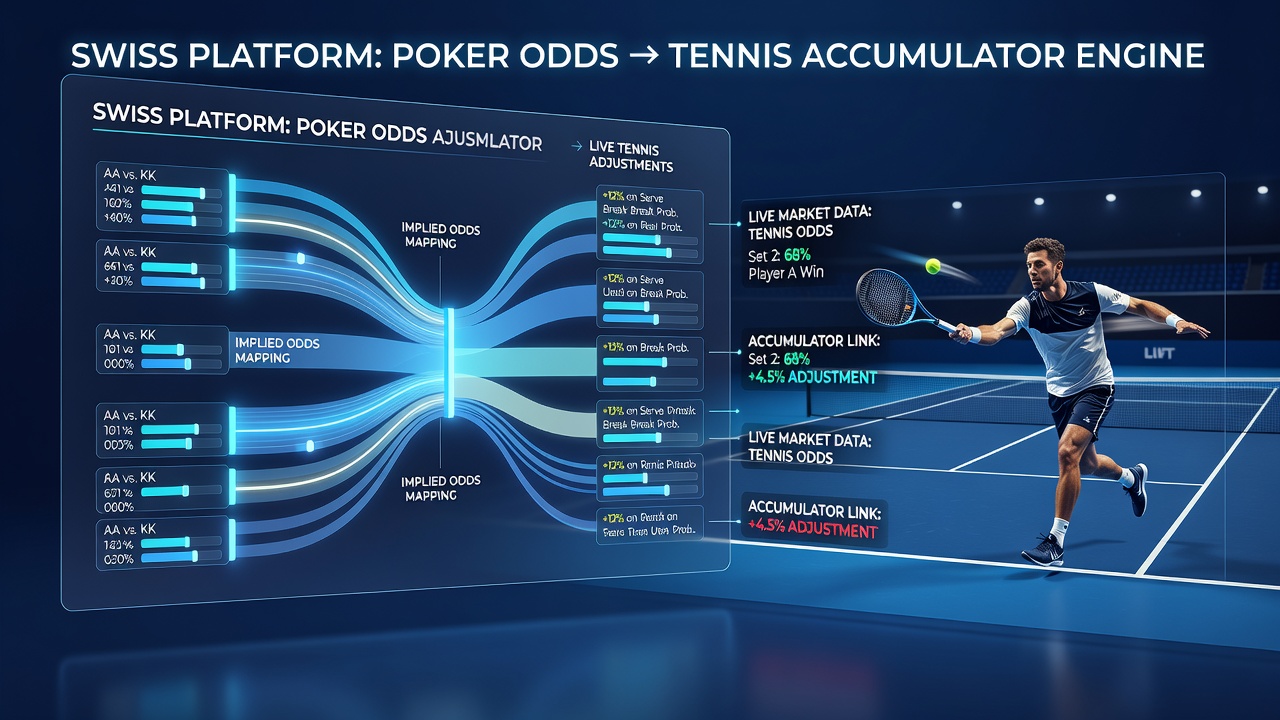
Researchers at institutions studying gaming mathematics have documented how poker hand probabilities, calculated through combinatorial enumeration and Monte Carlo simulations, provide templates for estimating point-by-point outcomes in tennis. Platforms extract metrics such as implied probabilities from specific hand matchups and map them onto tennis variables including serve percentages, break-point conversion rates, and fatigue indicators during extended rallies. According to reports from the Swiss Federal Gaming Board, these mappings occur through standardized application programming interfaces that update accumulator multipliers every few seconds during live play, ensuring that a sudden shift in one tennis statistic triggers proportional recalibrations across linked bets.
Accumulator Structures in Live Tennis Markets
Accumulators in tennis combine multiple selections such as set winners, game totals, and player performance thresholds into single wagers with compounded odds, and Swiss operators adjust these structures by importing variance factors derived from poker simulations. When a player wins an early set, for example, the platform recalibrates remaining legs using poker-style equity adjustments that account for remaining uncertainty ranges rather than simple linear projections. Figures released by the European Gaming and Betting Association reveal that accumulator volumes on Swiss sites increased by 18 percent in the twelve months leading to September 2026, coinciding with the adoption of poker-linked adjustment engines that reduced overexposure on high-variance matches.
Technical Integration Processes
Engineers at Swiss platforms configure backend systems to ingest poker hand outcome distributions and apply them as weighting coefficients within tennis accumulator algorithms, and this process involves mapping poker river-card probabilities onto final-set deciders or tie-break scenarios. Real-time data feeds from tennis matches feed into the same calculation layers that process poker hand histories, allowing simultaneous updates across both verticals without separate risk silos. One documented implementation uses decision-tree structures borrowed from poker solvers to branch accumulator payout scenarios based on live score differentials, with thresholds set according to historical poker session variance data aggregated across thousands of hands.

Regulatory Context and Compliance Measures
Swiss licensing requirements mandate that operators maintain transparent records of cross-product risk models, including those transferring poker-derived parameters into tennis markets, and the Federal Gaming Board conducts periodic audits of these linkages. Platforms must demonstrate that accumulator adjustments remain within predefined exposure limits even when poker variance inputs spike during volatile match periods. Data compiled through 2026 indicates that compliance documentation now includes side-by-side comparisons of poker hand equity curves and tennis accumulator sensitivity analyses, ensuring regulators can verify that adjustments reflect measurable statistical relationships rather than arbitrary shifts.
Observed Market Impacts Through 2026
Industry reports covering Central European operators note that Swiss platforms employing poker-linked systems recorded lower incidence of large accumulator payouts during extended tennis matches in the summer of 2026, because the adjustment mechanisms distributed risk across probability bands derived from poker simulations. Observers at the Swiss Institute for Gambling Research have tracked how these integrations affect player behavior, with data showing steadier betting volumes on multi-leg tennis wagers when platforms publish explanatory notes on the poker-model origins of certain odds movements. In September 2026, several operators introduced user-facing dashboards that display simplified versions of these cross-game linkages, allowing bettors to review how specific poker hand ranges influenced the current accumulator pricing.
Future Developments in Cross-Game Modeling
Academic studies from ETH Zurich have examined the broader applicability of poker probability engines to other live sports, and Swiss platforms continue to refine the tennis-specific implementations based on feedback from regulatory reviews. Updated protocols scheduled for late 2026 aim to incorporate additional poker-derived metrics such as implied fold equity analogs for player retirement risk in tennis, while maintaining separation between the underlying data sources to satisfy compliance standards. These ongoing adjustments reflect documented patterns in how operators balance innovation in odds modeling with the requirement for verifiable, auditable risk controls.
Conclusion
Swiss platforms maintain these connections through documented algorithmic pathways that transfer poker hand probability structures into live tennis accumulator systems, supported by regulatory oversight and technical infrastructure that evolved through 2026. The approach relies on established mathematical correspondences between combinatorial risk calculations in poker and dynamic probability updates in tennis, with market data confirming measurable effects on accumulator volumes and payout distributions. Continued refinement of these linkages aligns with Swiss licensing expectations for transparent risk management across product categories.